

On this page
- What Is a Decompression Chamber?
- What Is a Hyperbaric Chamber?
- What Is the Difference Between a Decompression Chamber and a Hyperbaric Chamber?
- Why Do Naval and Diving Contexts Use "Decompression Chamber"?
- What Is a Recompression Chamber?
- What Is the Difference Between Hyperbaric and Hypobaric (Barometric)?
- Which Term Should a Buyer Use in a Procurement Document?
- Frequently Asked Questions
- Conclusion
“Decompression chamber” and “hyperbaric chamber” most often describe the same class of pressure vessel. The naming difference is contextual, not technical: the U.S. Navy Diving Manual has used “recompression chamber” since its early editions for the same hardware that clinical regulators at the FDA classify under “hyperbaric systems.” Procurement teams that understand this terminology map write sharper specifications and avoid avoidable sourcing delays.
Key takeaways
- “Decompression,” “recompression,” and “hyperbaric” chamber all refer to pressure vessels designed to maintain internal pressure above 1 ATA with human occupants inside.
- Naval and diving procurement says “recompression chamber”; clinical buyers say “hyperbaric chamber.” The underlying engineering is identical.
- Hypobaric (barometric) chambers do the opposite: they reduce pressure below atmospheric to simulate altitude. They are not interchangeable with hyperbaric vessels.
- ASME PVHO-1, Safety Standard for Pressure Vessels for Human Occupancy, governs all variants regardless of sector label. (ASME PVHO-1, current edition)
What Is a Decompression Chamber?
A decompression chamber is a sealed, pressurised enclosure used to control the rate at which a person’s body returns to surface pressure after exposure to elevated ambient pressure. The U.S. Navy Diving Manual (NAVSEA SS521-AG-PRO-010), one of the most widely cited references in commercial and military diving globally, defines standard pressure schedules requiring a chamber capable of holding pressure at multiple depth equivalents. The term originated in military and commercial diving, where rapid pressure reduction creates the risk of decompression sickness (DCS) from dissolved gas forming bubbles in tissue.
The chamber itself is a hard-shell pressure vessel rated to a specific working pressure, fitted with viewports, through-hull penetrations for gas supply, communication systems, and lock hatches depending on configuration. Single-lock units handle standard surface decompression. Double-lock units allow personnel to enter or exit without fully depressurising the main occupied compartment, an important operational capability on active dive spreads.
What Is a Hyperbaric Chamber?
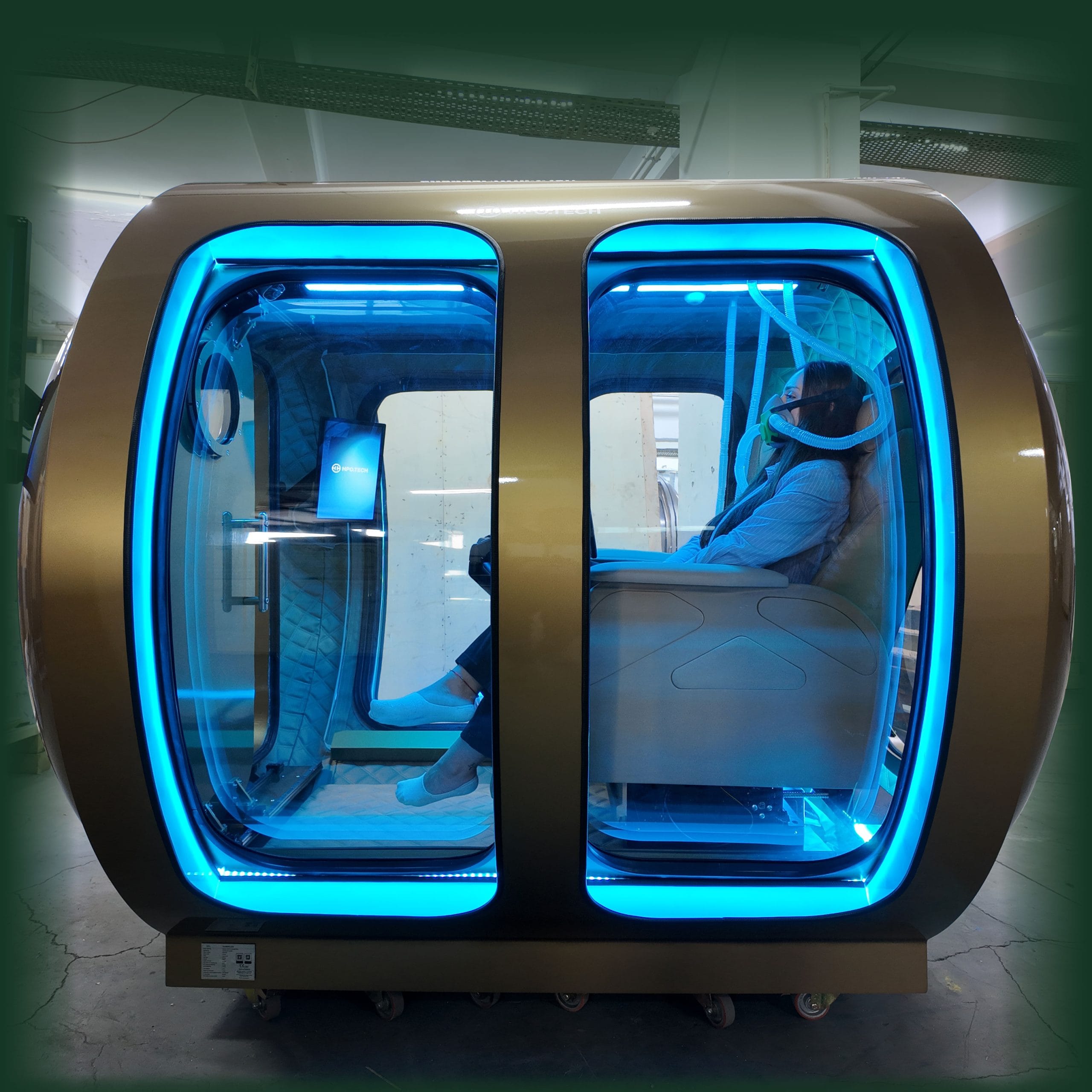
“Hyperbaric” derives from the Greek hyper (above) and baros (pressure). A hyperbaric chamber raises its internal environment above one atmosphere absolute (1 ATA, the standard sea-level pressure baseline). The U.S. Food and Drug Administration regulates hyperbaric chambers as medical devices under its 510(k) clearance pathway, while ISO 13485, the international quality management standard for medical device manufacturers, applies to the production facilities making them. The structural and engineering requirements are identical whether the procurement originates from a naval command or a clinical institution.
Multiplace hyperbaric chambers accommodate multiple occupants and pressurise with compressed air; occupants breathe enriched oxygen through a mask or hood. Monoplace chambers pressurise a single occupant directly with oxygen and are common in clinical and private settings. Both types share the same pressure-vessel engineering fundamentals governed by ASME PVHO-1.
What Is the Difference Between a Decompression Chamber and a Hyperbaric Chamber?
These terms describe the same fundamental hardware class: a hard-shell pressure vessel rated for human occupancy at pressures above 1 ATA. The International Marine Contractors Association (IMCA) standard D 014 references “decompression chambers” as required equipment on offshore diving spreads. Those same vessels, if transferred to a clinical setting, would be registered and regulated as “hyperbaric chambers.” The engineering specification, pressure rating, and safety systems are indistinguishable between the two contexts.
Decompression, recompression, and hyperbaric chambers all belong to the Pressure Vessel for Human Occupancy (PVHO) category. ASME PVHO-1, Safety Standard for Pressure Vessels for Human Occupancy, governs their design, fabrication, and inspection regardless of the operational label applied in procurement documents. The standard makes no engineering distinction between a “decompression” and a “hyperbaric” vessel: both require the same safety systems, materials, and inspection regime. (ASME PVHO-1, current edition)
Same Vessel, Different Naming Conventions
The naming follows the industry using the equipment, not the equipment itself. Naval architects and diving superintendents write “recompression chamber” in their safety management systems. Hospital procurement officers write “hyperbaric system.” Defense acquisition documents from NATO member states often use “diving recompression chamber” following STANAG guidance. All refer to a pressure vessel that raises internal pressure above atmospheric and holds it there safely with human occupants inside.
Terminology Reference Table
| Term | Definition | Typical Sector | Pressure Direction |
|---|---|---|---|
| Decompression chamber | Pressure vessel that controls ascent from depth-equivalent pressure | Commercial diving, offshore oil & gas | Above atmospheric (hyperbaric) |
| Recompression chamber | Pressure vessel that re-exposes a person to elevated pressure after rapid ascent | Naval diving, rescue and emergency response | Above atmospheric (hyperbaric) |
| Hyperbaric chamber | Pressure vessel raising internal environment above 1 ATA | Clinical facilities, sport recovery, private use | Above atmospheric (hyperbaric) |
| Saturation diving system | Multi-component hyperbaric system for extended depth-equivalent living | Offshore oil & gas, naval special operations | Above atmospheric (hyperbaric) |
| Hypobaric / barometric chamber | Pressure vessel reducing internal environment below 1 ATA | Altitude simulation, aerospace research, sports science | Below atmospheric (hypobaric) |
Why Do Naval and Diving Contexts Use “Decompression Chamber”?
Naval and diving communities adopted “decompression chamber” because the primary operational scenario is managing ascent from depth, not elevating pressure for its own sake. IMCA D 014 requires a surface-supplied or bell-based diving spread to carry a decompression chamber matched to the maximum working depth of the operation. The terminology locks the equipment to its operational role in the dive spread rather than to an abstract pressure value.
This linguistic history has direct sourcing consequences. A naval architect writing a vessel specification searches supplier catalogues using “recompression” or “decompression” as primary terms. If a manufacturer markets exclusively under “hyperbaric chamber,” that specification writer may not find them, even when the equipment is technically identical. Procurement efficiency on both sides depends on vocabulary alignment between buyer and supplier.
What Is a Recompression Chamber?
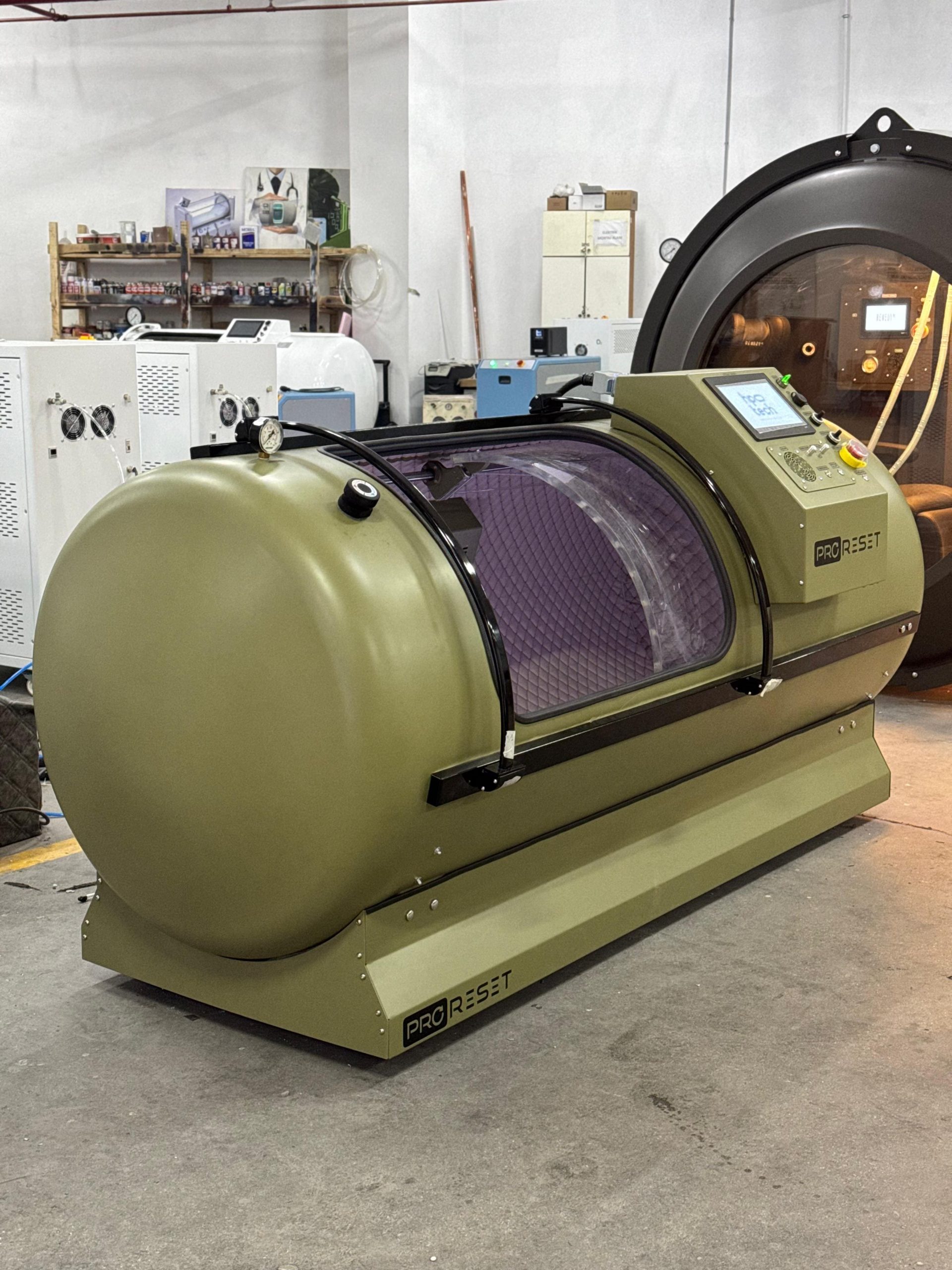
A recompression chamber is a hyperbaric pressure vessel used to re-expose a person to elevated pressure following a rapid ascent that has caused or is suspected to have caused decompression sickness. The U.S. Navy Diving Manual (NAVSEA SS521-AG-PRO-010) prescribes minimum pressure ratings and oxygen delivery requirements through its standard emergency pressure schedules, Table 5, Table 6, and Table 6A, which are the most widely adopted emergency protocols in commercial diving globally. These schedules define the minimum capability a chamber must have to serve a recompression role.
The functional distinction from a standard “decompression chamber” is subtle. A decompression chamber manages a planned, controlled ascent. A recompression chamber responds to an unplanned one. In hardware terms, most installations use a single vessel in both roles, switching function based on the operational situation. The equipment specification does not change between roles; only the operational context does.
The U.S. Navy Diving Manual’s standard emergency pressure schedule, Table 6, requires a chamber capable of pressurising to 2.8 ATA (equivalent to 18 metres of sea water) with 100% oxygen delivery to the occupant. The structural and gas-system requirements for a vessel meeting this specification are identical to those of a clinical hyperbaric chamber rated to the same working pressure. The same hard-shell PVHO engineering applies in both contexts. (U.S. Navy Diving Manual, NAVSEA SS521-AG-PRO-010, current revision)
What Is the Difference Between Hyperbaric and Hypobaric (Barometric)?
Hyperbaric and hypobaric chambers differ in pressure direction, not in their status as pressure vessels. Hyperbaric equipment compresses the internal environment above 1 ATA. Hypobaric (also called barometric or altitude simulation) equipment reduces internal pressure below 1 ATA. OSHA’s compressed air standard (29 CFR 1926.803) governs human occupancy in elevated-pressure environments in the United States. Hypobaric conditions, by contrast, simulate high-altitude environments where the partial pressure of oxygen is lower than at sea level.
Confusion between the two arises because both involve non-atmospheric pressure environments requiring pressure-vessel engineering. The structural loading is inverted, however. A hyperbaric vessel resists outward force generated by a compressed interior. A hypobaric vessel resists inward force, specifically atmospheric pressure acting on a low-pressure interior. These are different structural engineering problems requiring different design approaches and testing regimes.
Hypobaric and Barometric Chambers: Altitude Simulation Applications
Barometric chambers serve military aviation programs, sports science institutes, and aerospace research facilities. They simulate altitude conditions by reducing pressure inside a sealed enclosure to lower the oxygen partial pressure available to occupants. They are not interchangeable with hyperbaric or recompression chambers. The operational protocols, gas systems, structural loads, and regulatory classifications are categorically different.
Which Term Should a Buyer Use in a Procurement Document?
Use the term standard in your regulatory environment, then add the engineering definition alongside it. A clinical facility regulated by the FDA should write “hyperbaric chamber (pressure vessel for human occupancy, ASME PVHO-1, above 1 ATA).” A naval operator should write “recompression chamber (hyperbaric pressure vessel, ASME PVHO-1, working pressure [X] bar)” to match supplier search terms across both sectors simultaneously and receive comparable quotations.
ISO 13485 certification signals to a clinical buyer that the manufacturer maintains a quality management system validated for medical device production. CE marking under EU MDR 2017/745 confirms conformity for European clinical procurement. For naval and defense buyers, ASME PVHO-1 compliance combined with the applicable national or NATO defense acquisition standard takes precedence over clinical device classification frameworks. Both can apply simultaneously on dual-use chambers.
EN 14931, the European standard covering multiplace pressure chambers for medical use, and ASME PVHO-1, its North American counterpart, both apply to the same pressure-vessel class regardless of whether the buyer’s purchase order uses “hyperbaric chamber,” “decompression chamber,” or “recompression chamber.” Specifying the applicable standard by number in the procurement document eliminates terminology ambiguity in international sourcing and allows direct comparison of supplier submissions. (EN 14931; ASME PVHO-1, current edition)
RFQ Checklist: Six Fields That Resolve Terminology Ambiguity
Including these six fields in any pressure-chamber procurement document produces comparable quotes from suppliers across naval, clinical, and commercial sectors:
- Pressure direction: above atmospheric (hyperbaric) or below atmospheric (hypobaric)
- Working pressure: specified in bar or ATA
- Occupancy: monoplace or multiplace; number of locks (single or double)
- Applicable standard: ASME PVHO-1, EN 14931, or equivalent national standard
- Regulatory framework: FDA 510(k) clearance, CE MDR 2017/745, or defense acquisition standard
- Gas supply configuration: air pressurisation with onboard oxygen delivery, or direct oxygen fill (monoplace)
Frequently Asked Questions
Is a decompression chamber the same as a hyperbaric chamber?
Yes, in engineering terms. Both are hard-shell pressure vessels designed to maintain internal pressure above 1 ATA with human occupants inside. The difference is nomenclature: diving and naval sectors use “decompression” or “recompression,” while clinical and commercial sectors use “hyperbaric.” ASME PVHO-1, Safety Standard for Pressure Vessels for Human Occupancy, governs the design and inspection of both identically. (ASME PVHO-1, current edition)
What is the difference between a recompression chamber and a decompression chamber?
A decompression chamber manages a planned, controlled ascent from depth-equivalent pressure. A recompression chamber re-exposes a person to elevated pressure after an unplanned rapid ascent. In practice, the same physical vessel commonly performs both roles on working dive spreads. The U.S. Navy Diving Manual (NAVSEA SS521-AG-PRO-010) prescribes the minimum pressure ratings and oxygen delivery capability a chamber must have to qualify for recompression operations.
What is a hypobaric chamber and how does it differ from a hyperbaric chamber?
A hypobaric chamber reduces internal pressure below atmospheric (below 1 ATA) to simulate altitude conditions. A hyperbaric chamber raises internal pressure above atmospheric. The structural loading is inverted: a hyperbaric vessel resists internal pressure pushing outward; a hypobaric vessel resists external atmospheric pressure pushing inward. They serve different operational purposes and are not interchangeable in procurement documents or on-site deployment.
Which certifications should I look for when sourcing a hyperbaric or decompression chamber?
For clinical procurement in the United States, verify FDA 510(k) clearance. For European clinical buyers, confirm CE marking under EU MDR 2017/745. For manufacturing quality, ISO 13485 is the reference standard. Naval and defense buyers should confirm ASME PVHO-1 compliance alongside any applicable national or NATO defense acquisition standards. Chambers intended for offshore diving spreads should additionally meet IMCA D 014 requirements for the rated operational depth.
Can a hyperbaric chamber be used as a recompression chamber?
A hyperbaric chamber built to ASME PVHO-1, rated to the required working pressure, and plumbed for the correct oxygen delivery systems can serve a recompression role. The U.S. Navy Diving Manual and IMCA D 014 both define minimum technical requirements for this application. Buyers planning dual-use deployment, both clinical operation and diving emergency cover, should specify both use cases in the procurement document to ensure the correct pressure rating and gas panel configuration are included from the outset.
Conclusion
The terminology surrounding pressure chambers reflects history and sector convention, not engineering variation. “Decompression chamber,” “recompression chamber,” and “hyperbaric chamber” all describe the same fundamental technology: a hard-shell pressure vessel for human occupancy above 1 ATA, governed by ASME PVHO-1 or its regional equivalents. Buyers who map these naming conventions to the underlying engineering specification write cleaner RFQs, receive comparable quotations, and avoid sourcing delays caused purely by vocabulary mismatch between buyer and supplier sectors.
For naval, defense, and maritime procurement teams, contact HPO TECH to discuss chamber configurations relevant to surface-supplied and saturation diving operations. For a full overview of available monoplace and multiplace pressure vessel configurations across clinical, sport, and industrial use, see the monoplace and multiplace ranges.